


Yoshinobu Yamamoto: our world series MVP

Updated: May 15
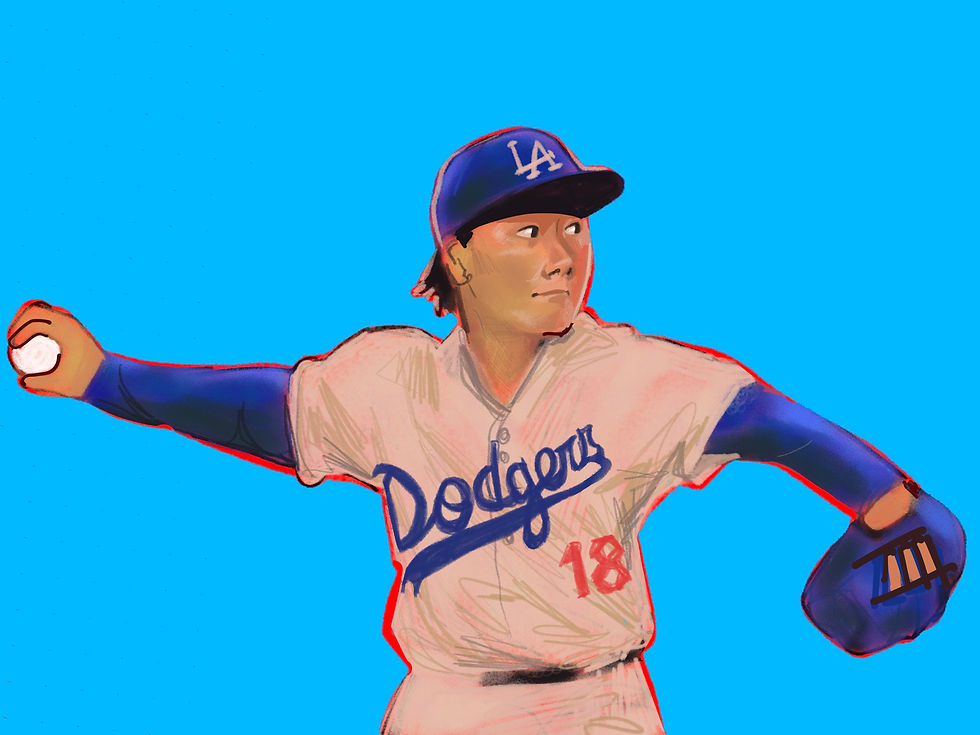
Yoshinobu Yamamoto: our world series MVP
You’ve probably seen the video where the Los Angeles Dodgers won the 2025 World Series in a dramatic fashion. If you haven’t, here’s a quick recap: in the 11th inning of Game 7, Yoshinobu Yamamoto induced a ground ball to Alejandro Kirk of the Toronto Blue Jays that bounced to Mookie Betts, who then jumped on second base to start the game-winning double play. Yamamoto was eventually crowned the World Series MVP.
As a Dodgers fan who has started to follow baseball a lot this year, I have learned many things. We all know Shohei Ohtani, and the fact that there really isn’t any other player of his caliber, but Yoshinobu Yamamoto, another Japanese MLB player, is often overlooked. However, after his heroics during the 2025 World Series (which I will go over), he is one of the most famous pitchers in the game, especially in Japan. Why is he so good, and how did he reach this level of dominance?

Yamamoto’s beginnings
Let’s take it back to where it all began. On August 17, 1998, Yamamoto was born in Bizen, a city located in Okayama Prefecture, Japan. His name was created by combining Japanese characters from his parents’ names. During his school years, he was the second/third baseman and catcher when playing baseball. He was a fragile young boy who got very emotional, as he described himself as crying a lot if he didn’t win a game. He had a huge hatred for losing games. Due to his very thin build, scouts often ignored him as they looked for boys with a more traditional shape; having a heavy, powerful body. This is because many believed that someone who had longer arms and more strength would be better in the majors. Despite these challenges, later in life, Yamamoto focused on an extremely unconventional practice routine and pitching full-time. But what was the driving force for him to commit to baseball this much, to the point where he would reach the level of national fame he has today?
Yamamoto’s unique training style
While Yamamoto was an infielder and catcher throughout elementary and junior high, he showed some pitching potential and therefore committed to the role during high school. Right after being drafted for the Orix Buffaloes in 2016 as a fourth-round pick, Yamamoto met a guy named Osamu Yada, who would go on to be his personal trainer. Around this time, he realized his smaller-than-average build wouldn’t sustain the same amount of rigorous exertion during practice that other pitchers would be able to, being told by Yada that it would be impossible to survive as a pitcher unless he abandoned regular training routines such as weightlifting.
With the help of Yada, this is when he developed his practice strategy that most pitchers would never even think of using. Others would normally put in all their effort into their muscles, requiring intense training often to maintain their level of play. Yamamoto, on the other hand, put very little effort into his muscles. Instead, he practiced yoga-like routines to maintain energy transfers, did handstands, and even threw a 90-gram mini-javelin (all things that he still does today) to sustain his ability to pitch. Yada would guide his training, instructing him to coordinate all 600 of his muscles in sync instead of just exerting them to throw hard. This is why he looks very relaxed in games - he relies on natural kinetic energy transfer to aid his throwing instead of traditional strength.
Historic Dodgers signing and rookie year
After a few years with the Buffaloes in Japan, Yamamoto would then have a 45-day window to talk to any MLB team after they posted he was able to leave for America. Starting on November 20, 2023, the offers from teams like the New York Yankees and Philadelphia Phillies began, and the stakes for the Japanese pitcher were high. Just a month later, on December 21st, he chose the Los Angeles Dodgers, signing for a whopping $325 million, twelve-year contract with no deferred money (meaning he’s guaranteed the full amount over 12 years). This shattered records for a pitcher’s contract, bypassing the Yankees’ $324 million, nine-year Gerrit Cole signing in 2020.
Despite his disastrous start in South Korea on March 19, 2024, giving up five runs in just a single inning, he bounced back quickly and was becoming the team’s most reliable pitcher before an injury derailed him for three months in June. During the Dodgers’ postseason run, he threw five scoreless innings against the San Diego Padres in Game 5 of the NLDS, helping the team advance to the NLCS and eventually, the World Series. While the 2024 World Series was mainly about Freddie Freeman and his heroics (remember that walk-off grand slam?), Yamamoto had his fair share of pitching in (no pun intended) in Game 2. Even though he gave up a solo home run to Juan Soto, he famously retired 11 batters straight to help the Dodgers take a 2-0 lead in the series, which they won in Game 5.
2025 World Series: MVP award
Yamamoto already had a dominant regular season in 2025, having a 2.49 ERA (earned runs allowed), the second best in the National League. However, he is best known for his postseason heroics. After Game 2 of the NLCS, where he pitched a complete game of one-run ball, even Derek Jeter himself thought that there was no way he’d do something to that caliber again. Well, Yamamoto proved the legend wrong on October 25, 2025, being only the 6th pitcher to pitch a complete game in a World Series since the start of the 21st century after his dominant Game 2 performance in which he retired 20 consecutive Blue Jays batters.
In that historic 18-inning Game 3 marathon where Will Klein pitched a masterpiece in relief before Freddie Freeman (again) walked it off, Yamamoto was seen in the bullpen getting ready to pitch in the 19th just in case, two days after his complete game. If you thought that was insane, he pitched on back-to-back days just a few days later for Games 6 and 7 right as the Dodgers were on the brink of elimination, becoming one of only four pitchers in history to win the sixth and seventh game of a World Series. His Game 7 performance in relief was arguably the most surprising and impressive, pitching 2.2 scoreless innings before getting Alejandro Kirk to ground into a double play in the bottom of the 11th inning to lead the Dodgers to a repeat championship, ultimately becoming the World Series MVP.
Yamamoto today
As of May 11, 2026, Yamamoto has a stellar 3.09 ERA in 43.2 innings and a 3-2 record with two no-decision starts (in which the game is tied when the starter has left or in which the bullpen loses the lead). He has also earned 40 strikeouts throughout the season. Yamamoto relies on a six-pitch arsenal: a 91 MPH cutter; a 77 MPH curveball; a 96 MPH four-seam fastball; a 95 MPH sinker; a 91 MPH splitter; and an 86 MPH slider (which he doesn’t use as often). To conclude this article, here are a few pictures from a Dodgers home game I went to, in which I was lucky enough to get the closest seat possible to the bullpen at the Gold Glove Bar. Yamamoto was the starter that night. While they did lose that game 4-1 to the Cleveland Guardians, he arguably delivered during the game, striking out two batters and pitching 6.0 innings despite not receiving enough run support to win. Here are a few photos I took. Enjoy!


Comments