


2026 Winter Olympics recap

Updated: Mar 5

Over the course of the past two weeks in Milan, the world has experienced pride, victory, and heartbreak, through the lens of the over 2,900 athletes competing in the 2026 Winter Olympics. Concluding February 22nd, 90 nations competed in 116 events across 16 disciplines. Below is a breakdown of the results and notable moments of each sport!

Alpine Skiing
Also known as downhill skiing, under this category the events are: Super-G, Downhill, Slalom, Giant Slalom, and Mixed team. Downhill is the fastest event, well known for including 5-time Olympian Lindsey Vonn who had a tragic crash on course, American Breezy Johnson dominated the women's side, while Switzerland’s Frenjo Von Allmen took Gold for the men. Team slalom, which is a technical two-person event combining sharp downhill turns, was again won by the Swiss men and the Austrian women. The individual Slalom event was won by Lolc Meillard and American Mikaela Shiffrin (her third gold). Giant Slalom (two runs, double the turns) was notably won by Lucas Pinheiro Braathen of Brazil who became the first ever Winter Olympic medal winner for South America. Frederica Brignone was the hometown hero for Italy in this event, also taking gold in Super-G (Super Giant Slalom). Switzerland came away with a dominant nine medals in all events, followed by Italy with an impressive five.

Figure Skating
Headlines this weekend were dominated by Alyssa Liu’s historic gold for Team USA who found success in the Team Event just narrowly taking gold from Japan. Ice skating (done by a pair), was won by France while Ilia Malinin’s surprise fall in Men’s Free skate made way for Kazakhstan's Mikhail Shaidorov to win his country's first figure skating gold. Women’s pair skating was won by Japan, and Alyssa Liu became the first woman in 24 years to take figure skating gold for the US.

Freestyle Skiing
Differing from downhill skiing with its rails and jumps, freestyle skiing incorporates Halfpipe, Slopestyle, Freeski, Mogul, Big air, Aerial, and Ski Cross events. Freeski slopestyle (course with jumps and rails) was won by Switzerland’s Mathilde Gremaud and Norway’s Birk Ruud while Freeski halfpipe (think of the U-shaped pipe) was won by US’ Alex Ferreira and China’s Eileen Gu whose win made her the most decorated freeskier of all time. Big Air, where skiers get three attempts to perform their best trick, was won by Canada’s Megan Oldham and Norway’s Tormod Frostad. Mogul skiing, where athletes navigate a steep, bumpy course with mandatory turns and jumps was won by Australia’s Cooper Woods and America’s Elizabeth Lemley. Aerial skiing (jumps of a steep ramp) was dominated by China taking the gold in both individual events, while the US won the mixed team final. Finally, Ski Cross was won by Italy’s Simone Deromedis and Germany’s Daniela Maier. All in all China came away with nine medals followed closely by the US with eight.

Bobsleigh
Bobsledding, characterized by its steel sled and rapid pace consists of the four-man, two-woman, two-man, and the monobob. Germany, historically dominated in the event, swept the podium for two-man and took gold and silver for the two-woman as well as the four-man. Monobob was the outlier event, with Elana Meyers taking home gold for the US. My question coming away from this– how does one discover they’re good at bobsledding?

Biathlon
By far the most insane Olympic sport, I literally could not believe my eyes when I read that this event combines cross-country skiing with rifle marksmanship, stopping to shoot at targets. Biathlon's mixed relay was won by Team France who also took home gold in the Women’s 15km, Men’s 10km, Women’s 4x6km relay, Men's 4x7.5km, and Women’s 12.5 Km (I know, a mouthful). Norway was also a dominant force, (yes, this was the event for the guy who admitted to cheating) taking gold in Men’s 15km, Women’s 7.5km, and Men's 20km.

Speed Skating
Speed skating, which turns out to be a lot more complicated than it seems, consists of a whopping 23 events (including short–track). Netherlands took gold in Men's 5000m relay and Korea in Women's 3000m. In team pursuits (synchronized three-person event: the one where they push each other forward) Italy triumphed for the men and Canada for the women. Netherlands took home a dominant 20 medals with Jutta Leerdam setting an Olympic record in the 1000m event. For the Americans Jordan Stolz went home with two golds and a silver for mens 500m, 1000m, and 1500m respectively.
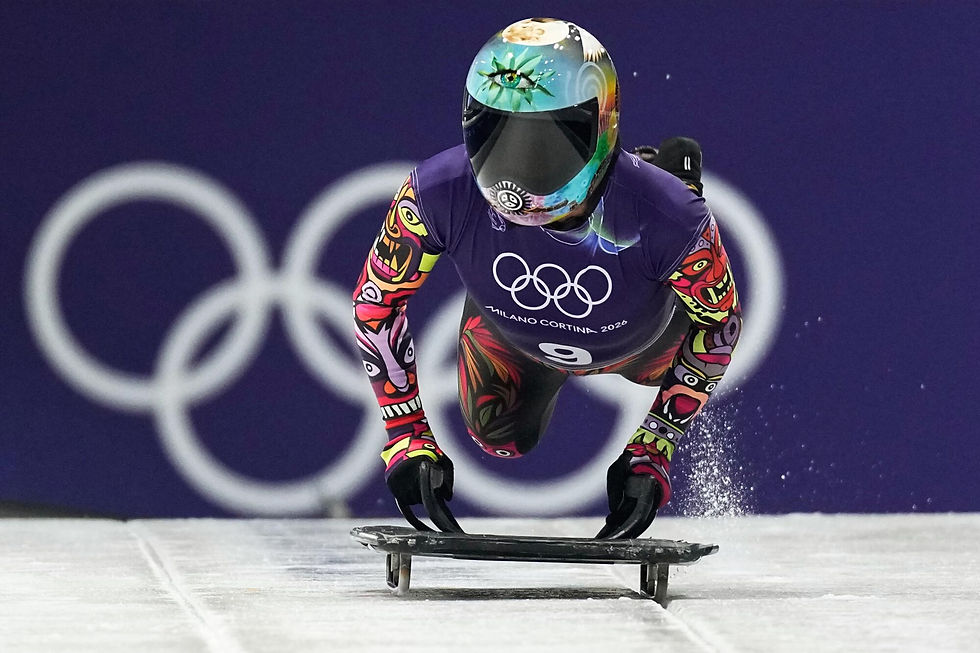
Skeleton
Arguably the most dangerous sport in the Winter-Olympics, Skeleton athletes race down the course in a small sled head-first. The UK’s Matt Weston took gold for the men, while Austria’s Janine Flock won for the women's. Mixed team relays was also won by the UK but it was Germany that ended with a dominant six podium finishes.

Snowboarding
With Big Air, halfpipe, freestyle, cross, and slalom events very similar to skiing, Japan was the big winner coming home with nine medals. Japan’s Kokomo Murase and Kira Kimura won the Big Air events on both men's and women's sides. Giant Slalom was won by Czechia's Zuzana Maderova and Austria’s Benjamin Carl. In women’s half-pipe, Korea’s Choi Gao-On narrowly won gold over American phenom Chloe Kim placing second. Yuto Tutsuko of Japan won for men’s halfpipe while Great Britain took gold in mixed team cross.

Luge
Taking a close second in the most insane winter olympic sport, in Luge two athletes lay ON TOP of one another on a sled steering with their calves as they race down an ice track. There is alternately singles luge (just one person) which was won by Germany on both men and women sides, while doubles was dominated by Italy’s men and women. The team relay luge was also championed by Germany, dominant in pretty much any sport requiring a sled.

Curling
Finally, a sport that looks like my mom sweeping under the couch: curling, historically dominated by Canada. Many this year heard of a cheating scandal having to do with a Canadian athlete pushing the disk with his finger tips, giving way for Sweden to take the gold for mixed team doubles and women’s side. While Canada did eventually triumph in the men's event.
All in all the 2026 Winter Olympics ended a satisfying mix of victory, excitement, and a lust for more. The next time we'll see these athletes in action on the Olympic stage will be in 2030 in the French Alps.


Comments