


An idiot's guide to Stardew Valley

By nature, humans are a nomadic species. We evolved to move from place to place, chasing whatever struck our fancy. At the time, we were enticed by different things than we are now. For example, an herby green drink was much less of a priority than real sustenance; seasonal produce, a hunk of fresh meat. We were hunters, gatherers, and cultivators; and as it turns out, we still have these inclinations. Even in the 21st century.
Released in 2016, Stardew Valley is a farm life simulator that scratches our itch to get our hands dirty. Less so involved with hunting than it is with gathering, the game’s outward purpose is to produce crops. However, there is more to farming than meets the eye. There is adventure, profit, and the pursuit of happiness. Who knew that raising crops would require a bold mixture of mining, flirting, and fishing? The life of a farmer is shockingly complex, and navigating it can be a lonely road. Luckily for you, there are people who have done the hard parts for you—and, unlike Wikipedia-–can explain things in words that are easy to understand.
No, you will not find any technical jargon in this article. And, potentially to your dismay, you will not find any detailed advice as to how your farm should be formatted. However, this guide will walk you through the fundamentals of playing Stardew Valley like an idiot: the way it should be played.

Upon arriving in the Valley, you will become acquainted with a colorful array of characters. You will soon realize that you have the option of befriending them, and eventually will be able to ‘romance’ a select few of these individuals. Do not be fooled, however. This lovely gaggle of geese does not love you for who you are. They are heavily materialistic, and will only be swayed by your ability to give them what they want. And unfortunately for you, they are picky. Even so, you will want to befriend them. There are indeed benefits, be them personal or professional. But you will have to go about it carefully, for if you give them something they are not fond of, they will not hold back their disgust.
So how can you befriend the denizens of Stardew Valley when you have nothing to give them? It’s simple– you wait. Business must come first, and farming must be prioritized. When the game starts, it will be Spring. You will be tempted to saunter over to Pierre’s– the local seed seller– and buy out his supply of flower seeds. Do not do this. Flowers, though pretty, are useless. What you should do in year one is prioritize parsnips. They grow fast, sell for a decent price, and will end up raking in the most cash. When you get the chance, immediately invest in an inventory upgrade.
As for the farm itself, do not begin by planting an unreasonable amount of crops. You will have to water them all individually, and this will consume the entirety of your stamina. Until you can upgrade your watering can, it is advisable to keep your crop yield relatively low. This will allow you to save energy, creating time for other activities. If you are interested in fattening your wallet, I would allocate time to fishing. If you are more so focused on long term crop yield, I would prioritize mining.
The mines, located North of town square, are filled with ores. From copper to gold, the mine’s earliest levels are rich with resources. Though you will encounter monsters, they are relatively low level and easy to avoid. Even if they get the better of you, death is not the end. You will respawn, lose a small sum of money, and your energy will be somewhat depleted. You can always return to the mines the next day, and at this stage of the game, losses are pretty minimal. Once you gather a sufficient number of ores, you will be able to craft a furnace. Once you have this, you will be able to smelt ores into bars. From here, you will want to pay a visit to Clint, the town blacksmith, where you can finally upgrade your watering can.

If mining is not your niche, that is probably a good thing. In all honesty, the most economical way to play Stardew Valley is to pursue fishing. Using a rod given to you by Willy— the town fisherman— you can reel in a diverse array of aquatic critters. You will catch different fish depending on season, location, and type of bait used. It sounds complicated, but don’t stress. At this point, bait is not something that you will have to worry about– nor is collecting a diverse array of fish. Even so, you can sell large quantities of fish for significant profits. Unless, like myself, you suck at the fishing minigame. If this is you, you can purchase a ‘training rod’ to make the game easier. However, I would not advise purchasing this rod. If you neglect fishing for long enough, Willy will mail you a training rod for free. It is somewhat insulting, but ultimately a smart move if you are trying to save money.
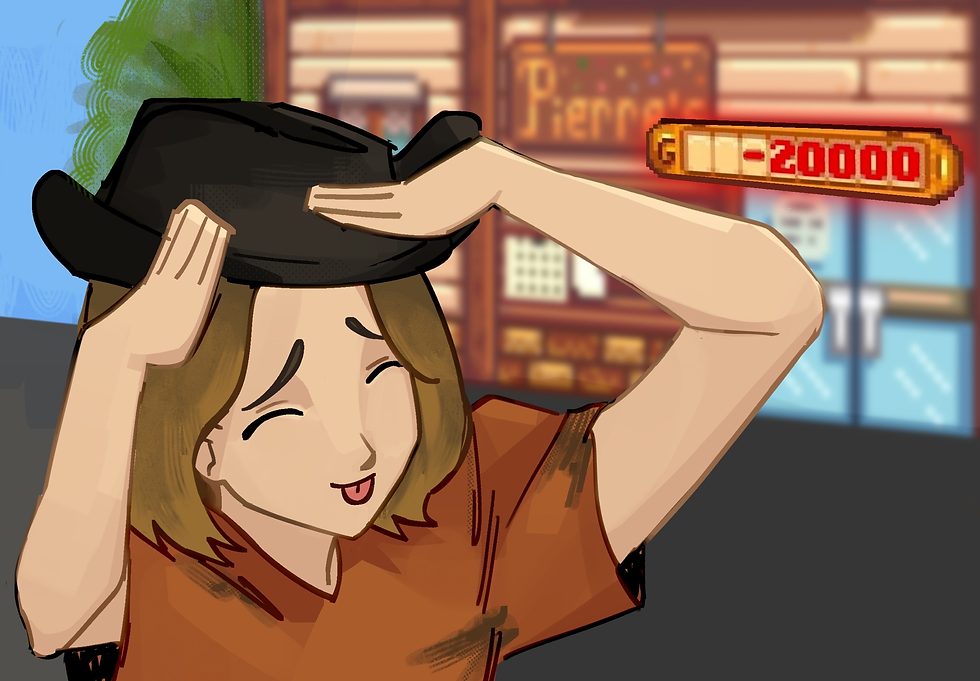
On the topic of conserving your funds, it is important to consider what your spending will look like. During Spring year one, it is unlikely you will be able to afford much. Blowing all of your money at Robin’s carpenter shop is not a viable option for you at the moment, and unfortunately, the cosmetics of your farm will have to wait. Investing in seeds, farm structures, and tool upgrades should be your priority. This way, during the winter season—when farming is off the table—you will be able to spend time decorating your farm. However, if there is something that you just must have, a small lapse in judgment is not the end of the world. For example, during the egg festival on spring 13, a giant pink bunny is on sale. Frankly, you would be a fool not to buy it. Yes, you will have the opportunity to purchase it in the future when 2,000 g is not a significant amount of money, but then you have to wait a whole year! Not everyone can have that degree of patience… debt really isn’t that bad, if you think about it.
Being transparent, spring year one is not the optimal time for developing friendships. Really, it is a time to explore the town, format your farm, and figure out the trajectory of your playstyle. However, if it is a persistent desire, then there are some villagers that are easier to befriend than others. For example, Emily— a quirky, blue haired bar tender-– is very fond of common stones that can be found on low levels of the mine. You can easily grind out some quartz and amethyst, gaining her fancy relatively quickly. If you’re lucky (and really persistent), you may be able to marry her before the year is out. As for other characters, their refined palettes often take a while to satisfy; becoming more of a priority in the Fall or Winter season of year one.

At a certain point, you will encounter the “Junimo”, little aliens that will provide you with tasks called “bundles”. Some of these will take a while to complete depending on your playstyle, and all of them will take multiple seasons. Along with your daily chores, it is smart to keep up to speed on what exactly these bundles require. Oftentimes, you may accidentally sell something that may have been valuable to the Junimo. Being mindful of what you export, be it through sales or gifting, is key in the completion of farm bundles. When you do complete a bundle, there are substantial rewards that will pay off later in the game. In Spring year one, make sure to complete the bundles that you can, even if they are limited.
Overall, Spring year one is a journey, and it will vary depending on what you as a player may prioritize. Perhaps you will want to revert to human instinct, seeking to hunt and gather as we did in the days of yore. Perhaps you will want to direct your own episode of The Bachelor. Perhaps you will prioritize fishing like a loser. The world is your oyster, and the vinegar is yours to decide.


Comments